
There is a fascinating theory I came across once while reading about autism — the idea that neurodivergent children live outside the realm of reality. That, for them, the world is not a collection of tangible, living things, but rather an abstract creation — something that exists in thought, perception, and interpretation more than it does in the physical sense. At first glance, it sounds strange. How could someone see the world as unreal when they touch it, breathe it, and live within it just as we do? But the more I sat with it, the more I began to understand what the author might have meant.
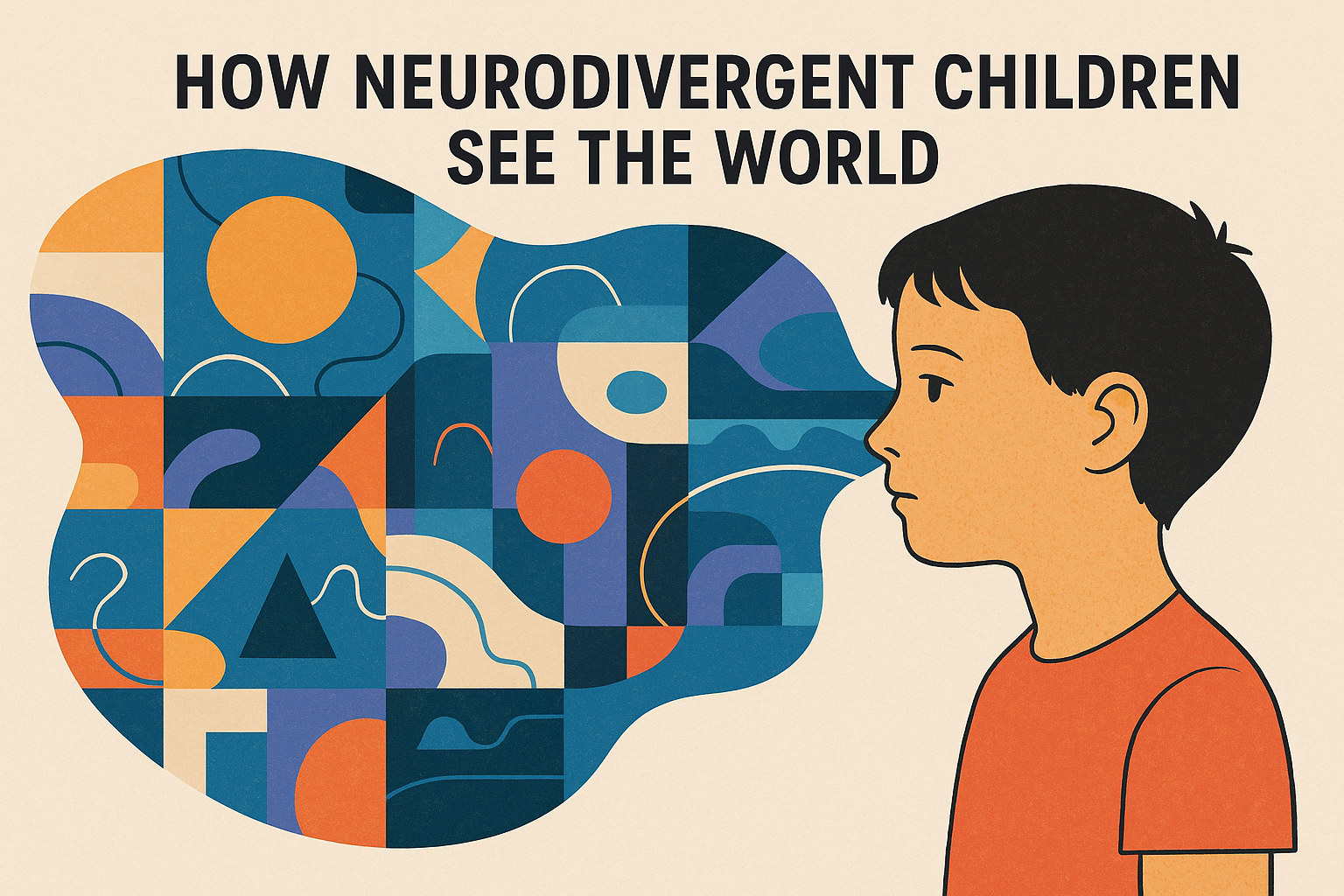
For many neurodivergent individuals — especially those on the autism spectrum — reality doesn’t always appear in the same format that neurotypical minds interpret. Where we see solid lines, they might see patterns. Where we see order, they might sense chaos. It’s not that their perception is wrong or broken; it’s that it is uniquely wired. Their sensory processing, their interpretation of emotions, their understanding of language and nuance — all of it forms a lens that shapes the way the world is experienced.
Think about it this way: two people can stand in front of a painting. One sees a stormy sea; the other sees a dance of colors and brush strokes that have no form at all. The painting hasn’t changed — the perception has. For the neurodivergent mind, the world can often resemble that painting. It is vivid, full of details, textures, and patterns that the rest of us overlook. Yet, because of how their mind processes those details, the meaning they assign may not align with what we call “reality.”
This isn’t to say neurodivergent children don’t understand that the world is real. They do. They just interact with it differently. Where we might see a table as an object meant for eating, they might notice the way the light reflects off its surface, the sound their fingers make as they tap it, or the slight imperfection in the grain of the wood. Their experience of that table is not confined to function — it is layered, multi-sensory, and often metaphysical in nature.
That word — metaphysical — carries weight. It means “beyond the physical,” and in the case of many on the spectrum, that’s exactly how they experience existence. To them, emotion and sensation can take on shapes, colors, or even sounds. A happy moment might feel blue. A sound might have texture. Words can feel heavy or light. These are not figments of imagination but interpretations of sensory input. What for us seems ordinary can, for them, be an entire universe of meaning.
Society tends to separate “real” from “imagined,” but for the neurodivergent mind, that boundary isn’t always as clear. Their understanding of the world may merge thought and feeling, logic and chaos, all into one seamless experience. It’s not a distortion — it’s a different architecture of consciousness. One that can seem abstract to us because we’re used to neat boxes and clear rules.
I remember reading about one child who described people’s emotions as colors floating around their heads. When someone was angry, he saw red streaks that burned through the air. When someone was sad, he saw shades of gray. Scientists might chalk this up to synesthesia or heightened sensory association, but to that child, this was simply how the world looked. To him, it was not imaginary — it was truth.
And that’s where we, as parents, educators, and onlookers, often miss the mark. We try to pull them “into reality,” assuming they are lost in imagination or fantasy, when in truth, they are processing reality on a plane that is layered, intricate, and deeply personal. To them, the world is both real and symbolic, both physical and emotional, both seen and felt.
This is why communication can sometimes be so difficult. When they describe something in abstract terms — a feeling, a texture, a noise that no one else seems to hear — it’s tempting to dismiss it. But to them, it’s not abstract. It’s part of their lived experience. When they flap their hands or hum repetitively, it might be a way of aligning their senses with the rhythm of the world. When they stare at patterns on the floor or fixate on the flicker of a light, they may be interacting with a reality that feels more structured, more predictable, than the one we impose on them.
We might call our version of reality “real,” but who decides what real means? For some, real is the tactile world — the solid things you can measure and touch. For others, real is what you feel, sense, and connect with emotionally. Neurodivergent individuals often live at the intersection of both. They interpret the unseen currents — the emotions, the sounds, the subtle changes in energy — that most of us tune out.
Perhaps what seems abstract to us is their form of clarity. Maybe what appears confusing to us is, in fact, their version of order. When we say they live outside the realm of reality, maybe what we really mean is that they live in a world we have yet to fully understand.
At the end of the day, perception defines experience. And if neurodivergent children perceive a world filled with patterns, sensations, and unspoken meanings, then that is their truth — their reality. Ours may be grounded in what we can see and measure, but theirs might be built on what can be felt and intuited. Neither is wrong. Both are part of the human experience.
It’s easy to want to “fix” what we don’t understand, but sometimes understanding starts with accepting that not all minds see the world the same way. Some see the invisible connections between things. Some hear the rhythm of existence in ways the rest of us never could.
And maybe that’s the beauty of it all — that reality is not one thing, but many perspectives woven together.
So if a neurodivergent child lives outside your idea of reality, maybe it’s not that they are lost — maybe they are simply exploring a part of it you haven’t seen yet.
And that’s perfectly okay. It’s okay to see differently.